
Reuse
Reuse and recycle agro-industrial effluent.
The project
REsilient agriFood system through REuse and Safe Handling of effluents
Who Are We?
The Mediterranean agro-food sector is a cornerstone of rural economies, yet it is also a major consumer and polluter of freshwater resources.
Olive mills, tomato-processing facilities, and dairies alone generate millions of cubic meters of high-strength effluents each season, thereby increasing the grey Water Footprint (WF) and accelerating salinization, soil degradation, and climate vulnerability.
The RE-FRESH project, aligned with the PRIMA Topic “Water management in the NEXUS”, demonstrates how these effluents can be rapidly and cost-effectively transformed into safe irrigation water, renewable energy, and biobased soil enhancers.
Reuse and recycle agro-industrial effluent.
Reintroduce regenerated water into aquifers or fertigation lines.
Regenerate soil and produce biogas.
Retain more moisture in soils.
Overall goal
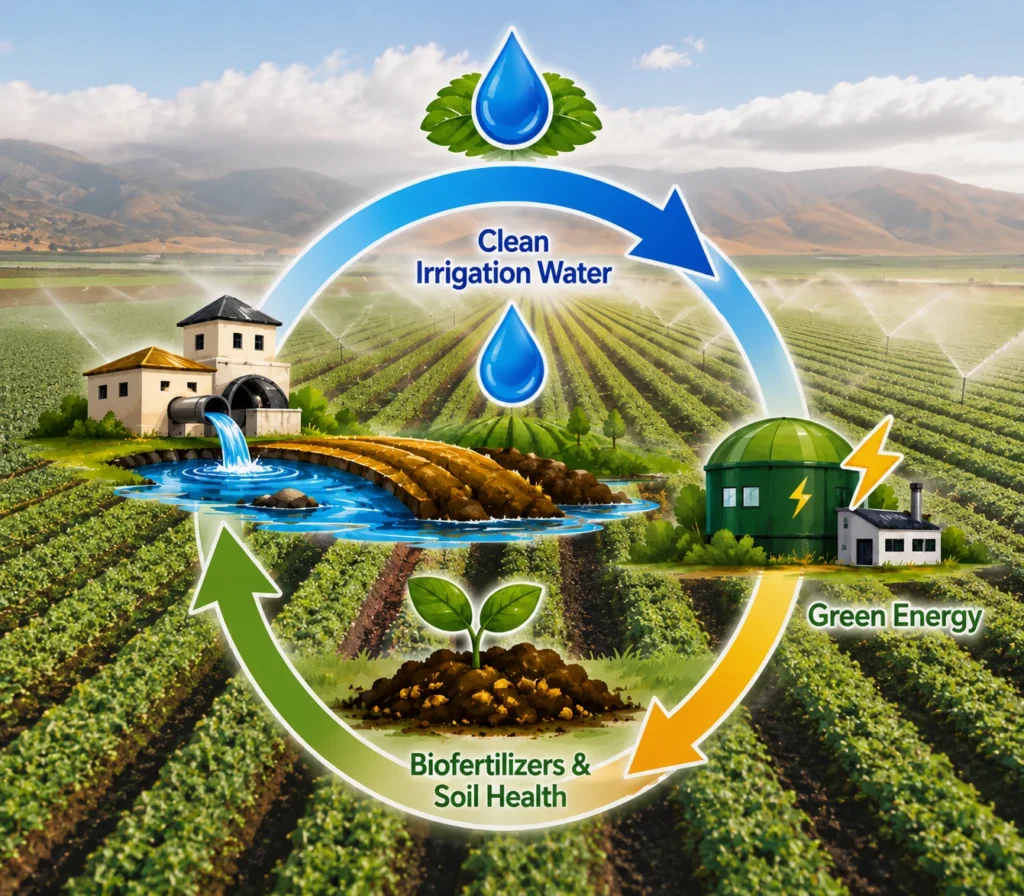
RE-FRESH combines the reuse of agro-industrial effluents, regenerated water, soil recovery and renewable energy within one circular model.
These four pillars reduce blue-water withdrawals, decrease grey-WF, and strengthen the Water-Energy-Food-Ecosystem (WEFE) NEXUS.
Innovation
RE-FRESH integrates Water Footprint (WF) and Virtual Water (VW) assessments with territorial analysis focused on the hydrographic basin, enabling water reuse strategies aligned with local hydrological dynamics. Production chains with high water dependence and significant recovery potential are prioritized according to the environmental and socioeconomic impact of their territories.
Its multi-criteria framework combines Advanced Oxidation Processes (AOP), anaerobic digestion, and fermentation for microbial biomass production with nature-based solutions, including plant biomass to enhance solar disinfection (SODIS).
Agro-industrial effluents are valorized into a clean energy carrier through a biologically driven process suited to decentralized Mediterranean contexts.
Locally available resources support effective water disinfection in low-tech settings where solar energy is abundant.
Recovered effluents generate biomass for soil improvers, biostimulants, and fertilizers while closing nutrient and carbon cycles. Agronomic treatments will also be evaluated on drought resistant varieties.
Project approach
RE-FRESH advances Water Footprint measurement with special attention to the often-overlooked grey component associated with water pollution, providing a more complete view of environmental impacts and water use efficiency.
Scalable and modular prototypes will be designed for agro-industrial supply chains and isolated rural communities.
The project will also model the regulatory and strategic implications of its solutions, contributing to climate resilience strategies and water risk mitigation policies at regional and international levels.
View project objectives
Ambition
RE-FRESH addresses water scarcity, soil degradation, pollution, and the vulnerability of agricultural supply chains.
The technologies and models developed through RE-FRESH will enable significant advancements in sustainable water and resource management.
Explore the work program